Showing posts with label salad. Show all posts

11 November 2011

Aubergine and bread salad +


This was one of those spur of the moments meal. I'd been down to Ridley Road and picked up a bag of baby aubergines for £1. (Yes: one pound for about fifteen or so hand length aubergines). Also four packets of beautiful baby plum tomatoes for a pound and a load of dirt cheap fennel. Crazy.

So I got back and pottered about with the back of my brain wondering what to cook for lunch: Szechuan aubergines, curry, some sort of soup... How about just sticking the aubergines and tomatoes on to roast and then chucking together a salad? Ok, let's give it a go.

  • baby aubergine
  • cherry tomatoes
  • fennel or some other raw veg
  • flatbread
  • feta or salad cheese
  • yoghurt, garlic, pomegranite molasses, lemon juice, olive oil and sherry vinegar

 Roast the aubergines and tomatos with olive oil for thirty minutes or so


Meantime: chop the fennel or other raw salad veg. I advise going for something with a little crunch here to contrast with the soft and silken vegetables. Roughly chop or mash your cheese (I used a cheap, mild Turkish salad cheese which was 1/4 the price of feta).

When the veg is half done in the oven put in your flat-bread (I used wholemeal pittas to nice effect). The aim is crisp them up and put them in the salad fattoush style. When they are getting semi-crisp take them out and chop roughly. Add to the veg and cheese. Dress with a bit of olive oil and stir. The bread will start to absorb the essence of the vegetables, especially via the liquid insides of the tomatoes.


Mix the yoghurt dressing - 80% yoghurt, 7% water, 7% olive oil, 4% pomegranate molasses and 2% sherry vinegar. Add one clove of garlic chopped very fine and some salt and coarse black pepper.


Layer up the salad base with the bread, put on top the roast veg and then dress liberally.


some preserved lemons would also work here with the cheese and bread

Very nice, though I say so myself, and substantial enough for a complete lunch. The roast vegetables are still warm, rich and comforting, the fennel faintly regal and stand-offish, the bread the doughty workhorse of the piece. A nice balance.

21 September 2011

Cucumber with malt vinegar


When I was a kid we used to sometimes have cucumber sliced very thin with malt vinegar. It was something that my mum had got from some elderly family friends who fled Poland as refugees in the 1940s.

My estate has a a community garden and vegetable patch. It has had some vegetables (tomatoes, pumpkins) planted in which is great, and though it needs a bit (quite a lot in fact) of TLC there were some cucumbers successfully getting fat and old that I managed to pick. These aren't your long smooth Dutch class of cucumber, but a specially spiked fatman variety, more like the little Middle Eastern ones. These four have been left a bit too long on the vine so the seeds had got hard and slightly unpleasant. Not a problem, I just scooped out the middle.


Slice your cucumber as thin as possible and add lots of malt vinegar. Sprinkle over a little sea salt . That's all. That's your lot.

For bonus points serve on a plate with an pre-eminent British general.

General Lord Kitchener of Khartoum

9 August 2011

On holiday in Venice and Sarajevo


I've not been ignoring the blog I promise. I've been on a summer holiday. First we were in Venice for their art festival the Biennale and then on (via overnight trains and a day of zombie-transit in Zagreb) to Sarajevo to the superb, yearly film festival. Here are some food highlights and snapshots.

coloured pasta in the tourist shops in Venice


no escape from the kebab


 a wonderful marble like statue - actually a giant candle

Italy is of course well famous for its food; the Balkans less so. Even now the Balkans in general and Sarajevo in particular make people think of the 1992-96 war  that followed the collapse of Yugoslavia and was the most biggest conflict in Europe since WWII.


15 years later and of course the city is very different, although you can still see the bullet trails on the buildings. It's definitely changed in the year I've been coming  to the film festival.


Bosnians love coffee. Every corner has a place selling it. Often you can get an espresso or a Bosnian coffee which is brewed in little copper pots with the grounds like its Turkish cousin. You can also get a cappuccino in lots of places should that be your wish.


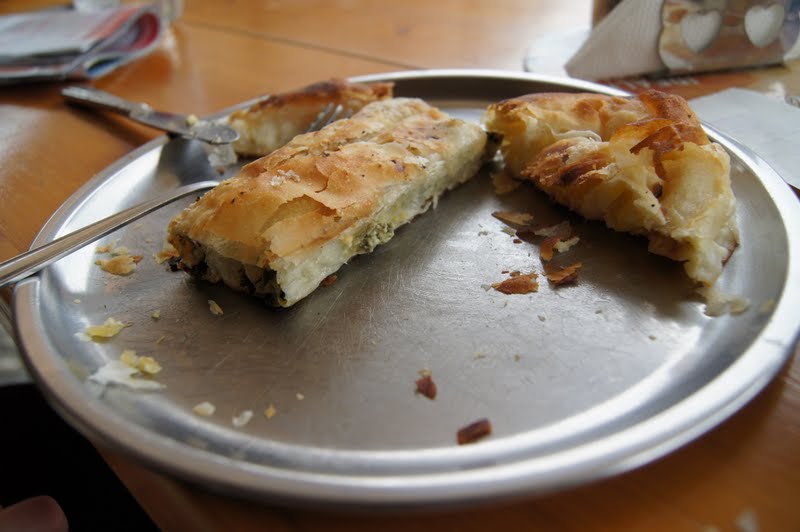
One of the other things Sarajevo does very well is pastries. The ubiquitous boreks are everywhere - a bit like giant coiled sausage rolls but with lamb - but the vegetarian equivalents are probably a bit nicer and definitely less greasy. Buying a sirnica will get you the same pastry with a mashed up cheese filling (like feta), zeljanica is the same cheese with spinach and krompiruĊĦa contains potato. The tried and tested spinach and cheese combo is delicious, whilst the potato is a bit hard going when combined with the pastry.

  
You can buy corn on the street for one KM (convertible mark).

Pizza in Sarajevo is the business! there are a few places in the centre where you can get slices of the proper stone-baked stuff


The Balkans are not great if you don't eat meat. Omelette, lots of cheese, some nice simple salads, pastas and sandwiches are all available for vegetarians but if you sit down to a proper meal and are after proper evening food its a bit thin on the ground. Typical Bosnian food includes hearty meat stews as above. A little bit of spice, lots of tomato and onion and some beef or veal cooked for quite a long time.


Best enjoyed with salad and a delicious unsweetened yoghurt drink.


As well as coffee (and despite a large Muslim population, many of whom are pretty secular) beer is also everywhere. At the Saraveo Pivara, an old brewery, you can get light, un-filtered light and dark beer in about five sizes ranging from 0.1l to one litre bad boy steins.


Bosnian bread is so much better than Italian! This is somun  and is the absolute business. Elastic, pure white dough with a slight blackening on the bottom and a sprinkle of black sesame seeds on top.


The bakeries in Sarajevo are amazing, loads of top-notch fresh stuff every morning.


We enjoyed it with some spreadable cheese that was also wicked.


On the last day we kept things simple.


17 February 2011

A salad with truffles and a mushroom pie of sorts

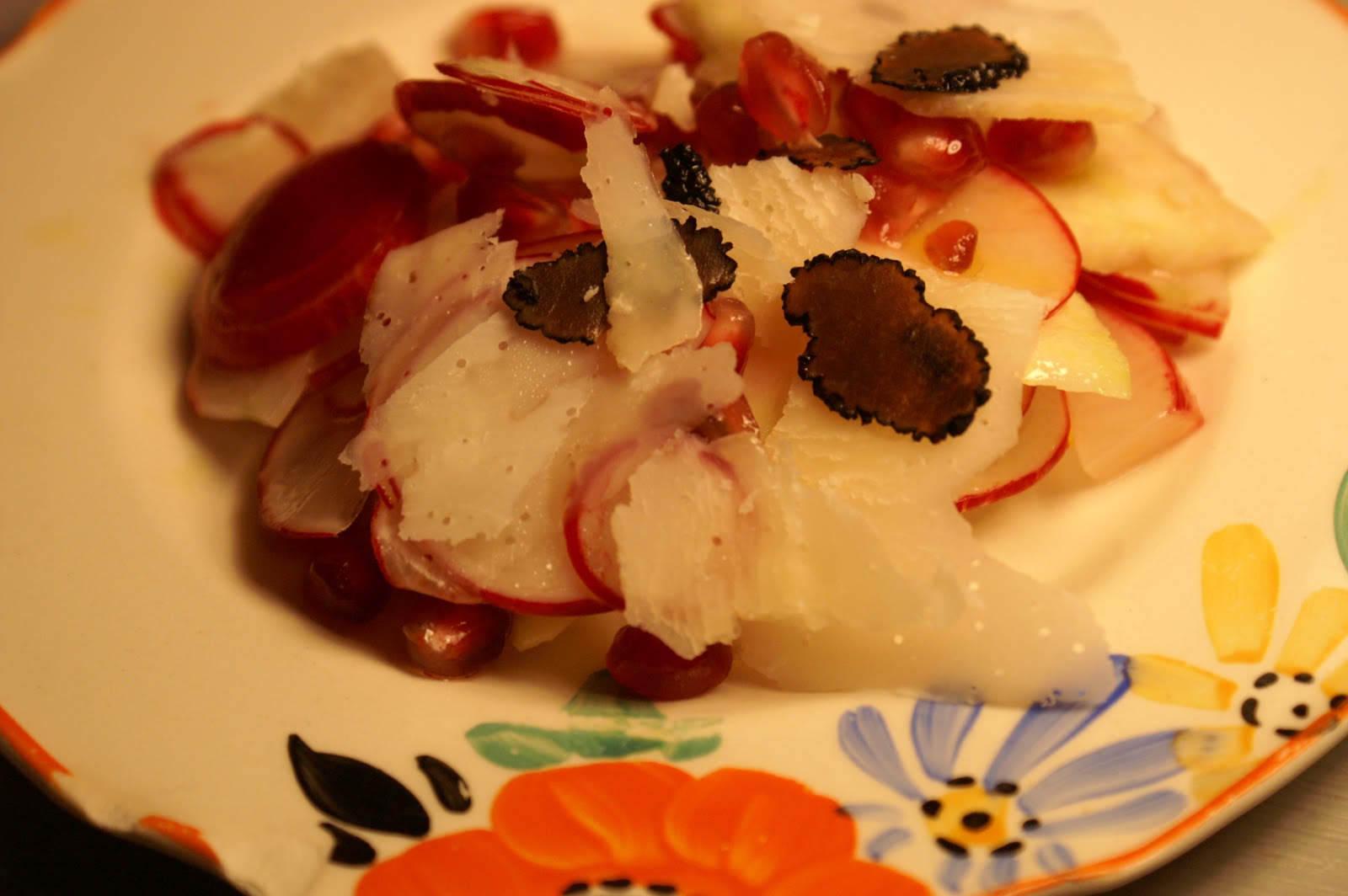
Nicked from Bocca Di Lupo, a valentine's day salad seemed like a good excuse for us to try some of the truffles waiting in the cupboard.
  • radish
  • celeriac or kohlrabi at a push
  • truffle or truffle oil
  • pecorino or parmesan
  • pomegranate

Slice the veg as thin as possible and artfully strew with pomegranate seeds (is seeds the right word?) and lashings of parmesan. Drizzle over the truffle oil and/or slice the truffle on top. Top up with some extra virgin and a splash of red wine vinegar.

When I've had this salad at the restaurant I think they also put parsley in it which is a good clean, green addition. The first time it combined normal radishes and slices of a giant black type and the second time radish with celeriac. Could it also work with mooli perhaps? I couldn't lay my hands on any celeriac so went for kohlrabi, remembering Bread & Wine doing something nice with it sliced raw and thin and dotted with a lemony oil. In truth I think it's a pretty rubbish vegetable but in thin slices it can at least lend a welcome crunch.

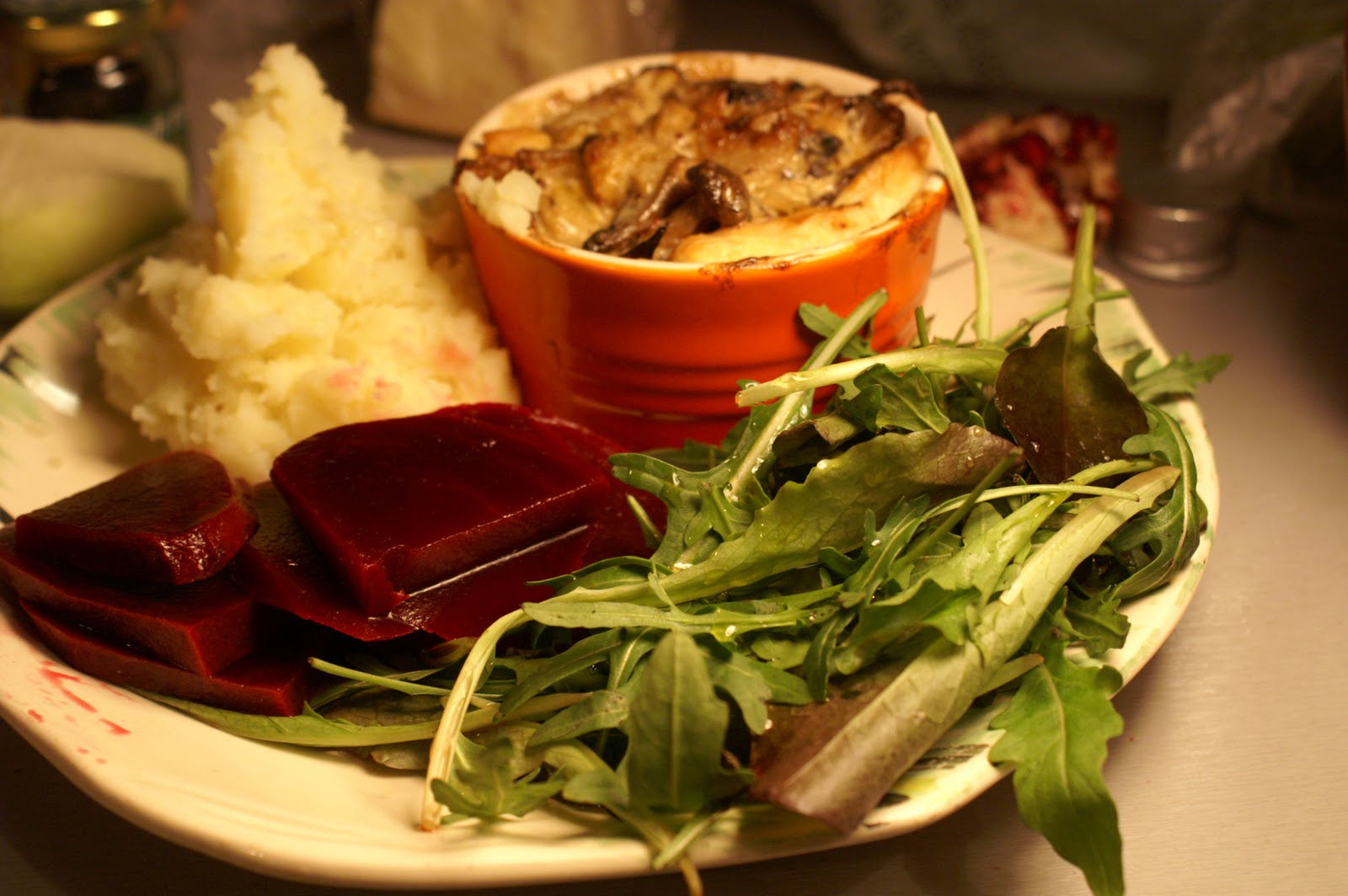
And then a supreme mushroom pie (kind of).


  • mixture of fresh musrooms
  • dried porcini
  • tin of those small and slimy Italian ones found sometime in antipasto
  • onion or leeks
  • double cream
  • sage, garlic, Dijon mustard and drop of balsamic vinegar

Blind bake some pastry pie-bottoms in remekins.

Fry the onions slowly for half and hour with some butter until really soft. Rehydrate the dried mushrooms in boiling water. Add sage and garlic to onion mix and fry, then add the fresh mushrooms. When their leatheriness had gone add the refreshed porcini with their juice and then the cream and vineger. Correct seasoning, add to the pastry shells and bake. The sage, cream and mushroom combo is the business!
 
 A fine dinner with some mash and veg

Happy valentine's day team.

26 January 2011

Sweet and sour poached leeks

This is a very nice side dish from the second Moro book.


I think the real key here is the make sure you use young and tender leeks. I used some bargain but borderline superannuated ones from Ridley Rd and their outer layer turned out to be extremely chewy. They were edible but after a going over the soft inner bit disappeared and just the stringy outer bit left with its gentle throttle on the way down.

The key to the poaching liquor is the sweetness from the sugar and the sourness from the lemons - I used chopped preserved lemons here and it worked well. Their salt-sour taste made the liquid extra jazzy. The books suggests using other green vegetables you may have to hand - peas, broad beans, cabbage or artichoke.

Ingredients
  • leeks, young and slim
  • sugar, water, garlic and lemon


    Old school

      Fry a few chopped garlic cloves in olive oil lightly and then added the trimmed and cleaned leeks. Add a couple of hundred mills of water, a tablespoon of sugar and either the juice of a lemon or some chopped preserved lemon. Poach until done - around fifteen or twenty minutes. Get some young ones and save the big woody leeks for the soup pot.


      With grain salad again

      I made this a week or so ago and, lo, what appeared on Ridley Rd this week but packs of tiny leeks!, snaffled naturally. In a bizarre reversal of the laws governing vegetable behaviour the leeks looks like small spring-onions whilst the actual spring-onions have gone rogue: giant, tough and whip like, barely fitting in the fridge. The little ones worked a treat with this dish.

      12 January 2011

      Yoghurt pie and grain salad

      What I like about Ottolenghi is that he suggests things I’d never make myself without prompting in a million years. Anyone can dream up a few salads or roast veg tarts and the like, but mixing yoghurt with chopped herbs and nuts, thickening it with flour and baking it is a combo that would not have cropped up in my head any time soon. Obviously I have inherent cultural bias and all the rest but just saying...


      As ever the ingredients were tinkered with as I’m mean and don’t like buying things when other things I have can do the job. Check the official recipe.


      The nature of the beast is this: fry some onion or shallot, toast a few nuts, chop lots of herbs and mix with rich (‘Greek’) yoghurt to form a thick paste. Season. Thicken this with flour and encase with vine-leaves slathered in melted butter and olive oil in an oven-proof dish. Sprinkle with breadcrumbs and bake for forty minutes.


      Pine nuts can be a bit dear and I found the walnuts I had worked fine. I also used normal flour instead of rice with no obvious adverse effects.


      I’ve gotta say I was initially wobbling on the fence a bit with this one – not outright horrid or anything you understand but not a straight-off head nodding success. But having some of it later and cooler after a trip to the pictures it started to make more sense. Rather than a hot pie this is much nicer as a room temperature slice of contrasting but complimentary flavours and textures – the leathery, briney vine leaves, the modest crunch of nut and crumb, the herbs in their giving yoghurt matrix, the butter sheen of fat that coats the thing. In fact, looking back at the recipe Otto specifies leaving it for ten minutes to cool – something I totally missed - eek!


      If I made this again I’d serve it more as a mezze component and add garlic to the onion/shallot stage.

      We had the pie with roast toms and grain salad – all you do is chuck in small amounts of every grain in the cupboard according to cooking time and then flavour when cool. We had puy lentils, rice, bulgar and orzo pasta with chopped preserved lemons and olive oil. Delicious.

      19 November 2010

      Peppers stuffed with saltfish and chorizo


      Saltfish. What other un-tinned fish can just sit in your cupboard waiting for a chill evening and a keen hand to remove and ready it for the pot? Nocturnally hydrated it is ready to lend its bounce to soups, salads, patties and pastes. Cookbooks sometimes stress how expensive saltcod is and how its availability is limited to Spanish and Italian delis. There is a simple way to get around both problems that they never seem to mention - get down to a local market with a Caribbean stall and fill your boots. I got three packets of saltfish (it's pollock but I guess we shouldn't be eating cod anyway right?) for five pounds.

      There is a recipe in the second Moro book suggesting stuffing spicy peppers with saltfish and I admit that it was the idea for this combination. But nothing was taken so so I'm claiming this one as a SD, ON (near) original!

      Ingredients
        • 400g saltfish
        • six spring onions or a similar amount of onion or shallots
        • 100g chorizo
        • 2 medium cooked potatos
        • five peppers
        • dried chilli, garlic, cumin


      Hydrate and desalinate the saltfish either by soaking overnight or boiling from a coldwater start a couple of times or until it tastes acceptably (un)salty. In the last boil put the potatoes in to cook cut into small chunks. When fish and potato are ready mash together in a bowl.

      Meanwhile soften the onions with plenty of garlic in a pan and add the chroizo to colour. Add chilli flakes, cumin  and black pepper to taste. Allow all to cook for a couple of minutes and lubricate with plenty of olive oil. When this mixture is ready combine with the saltfish and potatos and correct seasoning. Stuff this into the peppers and bake for forty-five minutes in a moderate oven until the peppers have started to break down and blacken on top. I had a few tomatoes in the mix too.


      For a salad I made a lovely Moro one - blanched cauliflower, chickpeas and preserved lemons dressed with olive oil thick with cumin seed and chopped coriander. This is a wonderful salad that should be made as often as possible.


      We had it with pittas.

      6 October 2010

      Leek vinaigrette and open pasta


      Leeks are wonderful - cheap and tasty, humble and trusty - they loose any allium harshness given a quick poach. I followed Simon Hopkinsons's directions from his Roast Chicken and Other Stories book in pairing them with boiled egg. He suggested grating the egg but I just sliced it.


      Very retro dish this one, and incredibly tasty. The vinaigrette is a simple one with lots of Dijon mustard and red-wine vinegar and thinned with a little water.


      Given  a post-Ridley Road glut of tomatoes and peppers (this time cherry toms and those small, very sweet orange pointed peppers) I opted to roast them and make an open, messy pasta dish with some lasagna sheets.


      The veg was roasted for fifty odd minutes with a lick of olive oil and some garlic. Once nice and soft and crinkly the tomatoes were squashed with a fork to make a sauce and Parmesan grated in. This gives a wonderfully savoury sauce to hold the larger pieces of pepper. It was then layered up with the pasta.


      It looks nicer a bit mashed up really. Some capers and olive oil and then you're ready to go! Wicked taste.


      PS Used leftover roasted veg to make lunches for the week.

      Added to bulgar (such an amazing grain - the perfect mouthfeel mix of nutty chew and gluten squidge and healthy to boot!) with dried chilli, green olives, the much-loved preserved lemon, parsley, leftover poached leek and a few mushrooms. Given sufficiently robust seasoning and some strong flavours such as olives or capers bulgar can complement anything and makes a great, cheap lunch.