Showing posts with label chicken. Show all posts

7 October 2011

Guinea fowl with cabbage and bacon

Ever since making Da Pan Ji way back in June I've had a second guinea fowl in my freezer. Now I'm a big fan of the fowl - to me it's like a farmyard-charged chicken. Not as fully gamed up as pheasant by a long way, but a hint of something beyond the quotidian enjoyment of the much abused chicken.

This recipe is a piece of piss I have to say. It's also really, really nice.
  • one guinea fowl
  • one cabbage
  • two glasses white wine and a bit of water (by eye - about half the amount of wine)
  • some smoked bacon
  • sage and/or bay, juniper berries, peppercorns


Brown your bird in some fat. You can walk around here and do a few odd jobs, just coming back every so often to flip the fowl.


When it's brown add the bacon in biggish pieces. It's really worthwhile using something smoked as this merges with the wine and meat juice to make an amazing light broth.

When this is cooked toss in all the other ingredients. It's nice to keep the cabbage fairly large, but small enough to cook through, so use your judgement here. I lifted the recipe from Ripailles, which suggested sage but I lacked that herb so substituted bay. I think the occasional peppercorn adds a certain pleasurably spicy note to this otherwise deliciously moderate combination.

Cook it all for forth-five minutes to an hour on a low simmer. The bird should stay very moist. Serve with boiled potatoes, a ladle of broth and some wholegrain mustard if feeling exotic.


This dish is that wonderful type of French farmhouse or basic bistro cooking and hits all the right notes - smoked meat, fresh green veg, fowl, wine, herbs. It doesn't get much easier for a top-notch Sunday dinner. I think I prefer this type of thing to a full on roast with all it's greasy crispness, but then I am generally predisposed towards things in liquid or stock.

22 July 2011

Chicken vindaloo

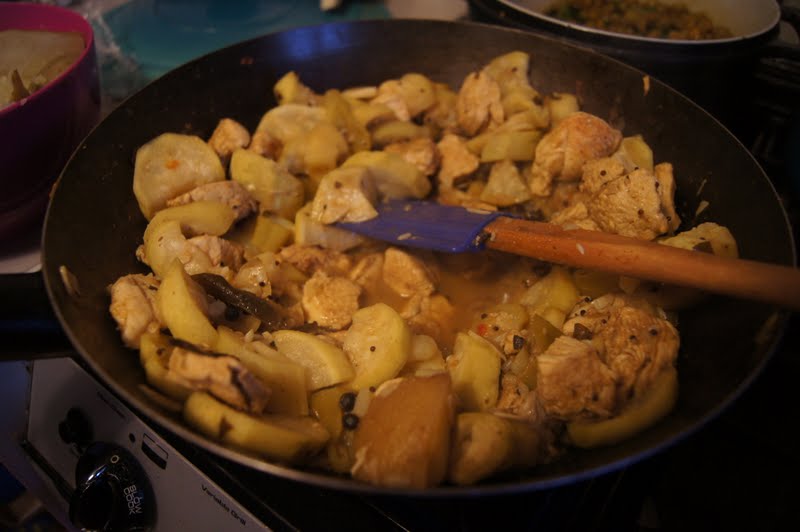
lauki, a type of calabash

OK we all know vindaloo is not just some ridiculous curry for pissed people that's hot as hell but not as interesting right? It's a child of Portuguese and Indian parents, like kedgeree a legacy of colonial expansion and consequent culinary syncretism. It's the vinegar that does it. I'm not much of a whizz with Indian food so I got Madhur Jaffrey's Curry Easy as a starting point and modified the recipe in it called 'chicken with vindaloo spices'. I think lots of vindaloos have a serious marinade, whereas this was perhaps more of a weeknight approximation. It was delicious - the vinegar gives a slightly sour, savoury note that goes very well with spices and garlic.


I put in some lauki which is very nice - slightly like the courgette which it resembles but with a crunchier texture post-cooking. Very absorbent for taking up the spices.

  • chicken
  • vegetables
  • garlic
  • vinegar (I used Turkish apple vinegar and it was fine)
  • brown mustard seeds, plenty of black peppercorns, curry leaves

Heat some oil and, giving each ingredient a minute to fry with a gentle stir add the mustard seeds, then black peppercorns, then curry leaves, then chicken, then loads of garlic, a decent amount of white wine or cider vinegar, a pinch of salt, some ground cumin and coriander and some chilli powder or flakes for heat. Cook for twenty minutes and should be done!


We had with rice and some green lentils boiled with turmeric and finished with green chilli and cumin seeds fried in ghee.

30 June 2011

Big plate chicken (da pan ji - 大盘鸡)

Remember the dish I described at Silk Road as my favourite of 2010? 'A massive pot of savoury liquor - red-brown and with aromatic anise steam rolling off it. The meat is in there on the bone as it some veg and chilli but it's really the flavour of the stock that is so incredible.' Well reader, I stumbled across a recipe for it and of course had to make it quick-sharp.

I had perhaps thought that 'big-plate chicken' was a clunky transliteration Silk Road had made rendering their menu into English. Not so. The classic Xinjiang dish is called Da Pan Ji which really does mean big plate chicken, a wonderfully literal name. Xinjiang is the most western Chinese province and borders the central Asian stans. Its people range in ethnicities and cultures, many are Muslim and of course eat quite different food to the Eastern Chinese diets we may be more familiar with. There is lots of lamb, there doesn't seem to be any soy-bean, it's all about the wheat (both noodles and flat-breads) rather than rice and yoghurt features. Having done some basic reading on it I came to think of it as a cross between the familiar Chinese larder of ingredients and the Turkish one.

Here is an article on the food and culture of the region - From Kebab to Nan (pdf) - and here a site dedicated to the culture of Xinjiang - Xinjiang, Far West China.


You can check da pan ji recipes from Read extensively of healthy lives and Lily's Random Diversions and some debate on the thread Big Plate Chicken/Chicken & Potato on EGullet. The recipe I chose to follow was from Chrisnw6. As ever I made a few tweaks.

First you need to get your chicken into manageable chunks. My chicken was actually a guinea fowl which worked out fine. Trying to chop it up  into chunks on the bone without a cleaver is bloody hard work. In the end I jointed it normally, smashed the thigh bones and cut the breast meat and back part into a few rough sections. The key is to have the meat on the bone - I think it's ok to keep the pieces a bit larger than might be traditional. I also recommend removing much of the skin as it makes the sauce rather greasy.


Then fry the spices in oil: Szechuan chillies and peppercorns, then cinnamon, star anise, bay, cumin and white pepper. Add a bunch of spring onions chopped and plenty of sliced ginger. Add the chicken and brown. Add some tomato purée. Then add carrots and potatos in chunks and cook for a few minutes. When it's all primed top up with water or beer. I used a light larger and a bit of water.


Stew until everything is cooked, adding chopped peppers and onions towards the end and serving with chopped coriander and thick wheat noodles or nan.


OK first of all: it's not as good at Silk Road's version. Quite a long way off actually. But in my defence I've never cooked it before. Secondly though: it is pretty good. A chicken hotpot with a Chinese aromatic heat and a Turkish feel. The potato and carrot make me think of a British casserole, the peppers, onions and tomato of a Mediterranean stew and the star anise and Szechuan pepper of Szechuan and Hunan. It's a pretty great combination.


20 May 2011

Dan dan noodles (dan dan mian) (kind of)

Just a quickie this one. Chicken breast is not normally something I have knocking around, possessing as it does a lack of taste and a monotony that almost renders it pointless (rubbish stuff that is), and generally fulfilling the meat needs of people who don't seem to actually like meat. But I got this stuff for cheap in a supermarket and I can never resist a bargain. Perhaps too, using up cheap ingredients and making do with what is available is all part of the traditional Szechaun approach to cooking! I wanted something quick and spicy. So I used a dan dan noodle recipe to try and make a chicken version of the Szechuan classic.

  • chicken (or minced pork for legit version)
  • noodles
  • spring onions and/or green vegetables
  • Shoaxing wine, Chinkiang vinegar, soy sauce, Tianjin preserved vegetables, chilli oil, Szechuan pepper

    Tianjin preserved vegetables

    Soak the noodles in boiling water. I used bean thread noodles which are transparent.


    Fry the preserved vegetables and set aside.

    Fry the meat and douse with some cooking wine, vinegar and soy sauce. Add some chilli oil and chopped spring onion. I added chopped courgette and spring greens here instead - obviously the flexibility of this type of cooking means you can use up whatever dregs are in your fridge at the back..

    When the meat is nearly done put the noodles in and add enough of their soaking water to ensure they  become fully cooked in the last couple of minutes that the meat needs. I didn't put in quite enough water at this point and the noodles retained a mild but unwanted bite.

    Toast some Szechuan pepper in a dry pan. Crush when fragrant (needs about four minutes - keep an eye on things to prevent burning).

    Taste and beef up the flavour with anything else it might need. I found it needed more than might be envisaged. I added some Hunan style home-fermented chillies too (the red below).


    Sprinkle with Szechuan pepper and serve. To be honest I don't think this works as well with chicken. The fatty, salty kick of the pork just marries so perfectly with the noodles and the spice. Still a decent and quick supper though.

    5 April 2011

    Chicken with cucumbers (ji chao huangguarding)

    home-preserved chillies Hunan-style - 
    just chopped red chillies and a pantagruelian salt portion!

    It think it's pretty clear from recent posts that I've got a lot of love for Fuscia Dunlop's Sichuan Cooking. But my enthusiasm for Szechuan (and Hunanese) food knows no bounds at the moment so I also picked up from Amazon's new-and-used section Mrs. Chiang's Szechwan Cookbook by Ellen Shrecker and the eponymous Mrs. Jung-Feng Chiang and The Good Food of Szechwan by Robert A. Delfs. The former is quite good whilst the latter I would not recommend purchasing.

    Mrs. Chiang's Szechwan Cookbook contains lots of classic dishes from the region, plus a few extra that aren't in FD's book like lion-head meatballs and some simple stir-fry combos like this cucumber and chicken one. The layout is slightly vexing, with the ingredients listed alongside the cooking directions so you have to scan the whole thing to get a sense of what's actually in it. But I think it's got potential to augment if not supplant Sichuan Cooking. (As an aside, the spelling 'Szechuan' is favoured in these two older American texts, whilst elsewhere you see 'Sichuan'. I have uses the former option is I think it looks nice with the zed, but I'm not sure how good a reason that is. I guess there is no clear transliteration.)

    Cooking cucumber has certainly been one of the revelations of getting into Szechuan food. So I liked the look of this simple recipe - chicken stir-fried with cucumbers and some classic flavourings of the region. 

    If you want to try the home salted chillies at the top of the page just chop some fresh red Indian type chillies and pour quite a lot of salt on to them (maybe 5-7% of their weight). Give them two weeks to mature. They might need a quick rinse to get some salt of before going into the food.
     
    • 1/3 cucumber per person
    • one chicken breast per person
    • two spring-onions per person
    • five cloves of garlic per person
    • Shaoxing wine, cornflour, pickled chilli, soy sauce, sugar, salt


      Slice the chicken and spring onion into similar sized pieces. You can see the size I went for, although the more authentic version in the book is based on quite small pieces. Marinade with the Shaoxing wine, a large dash of light soy sauce, pickled chilli, a pinch of sugar and another of salt, and a sprinkle of magic thickening dust for thirty minutes or so.

      Cut the cucumber into similar size pieces after eviscerating it with a teaspoon. Sprinkle with salt and leave to express its liquid if you have time. Otherwise just use as it is: I've often done this without any problems.


      Fry the cucumber for a couple of minutes to break the rawness and set to one side. Reheat the oil and add the garlic. Fry for thirty seconds. Add the chicken and spring-onion mixture and fry until it's cooked (only a few minutes). Tip the cucumbers back in and bring it back to full heat. Put in another slosh of soy sauce if you fancy. Serve.

      there's some noodles under here, honest guv

      It's quite a mild one this. You might not be satisfied if you're looking for a hot and fat chilli blast or associated numbing. But the ingredients definitely combine to make something more than the sum of their parts - something almost sweet and undoubtedly moreish.