Showing posts with label beef. Show all posts

17 February 2012

Steamed beef with rice meal (fen zheng niu rou)


The idea of steaming meat in a coat of rice flour is one that caught my eye a year or two, before I had even started cooking Sichuan or Hunanese food at home. It was in the form of the excellent Eating Asia's Mizheng Rou. Basically you slow steam meat with a load of spices and smashed up rice and the rice gradually cooks - absorbing the steam, the meat juice and your favoured exciting mix of spices. Meat and rice integrated, prepared together as one like in the great European dishes of risotto of paella.

Having never got around to doing something based on EA's version I ended up doing a version with beef from Land of Plenty. It's a bit more fiddly than, say a mapo tofu, or a braised fish in chilli bean sauce, but ultimately pretty interesting given the new textures brought by the rice and by the steaming.

  • 500g beef
  • ginger, garlic, chilli bean paste, soy, Shaoxing wine, veg oil, dash of water or stock - for the marinate
  • dried chillies, Sichuan pepper, sesame oil, raw garlic, spring onions
  • 75g raw rice

Cut the beef into largish, thin squares. Combine with the marinade ingredients and leave for half an hour.


Toast the rice until brittle. When it's cool grind down in a mortar and pestle - half way to a meal like state is fine, so there's still some texture. Add this to the beef and steam it for two hours. The rice will start to fluff up and increase in size. This dish should not be cooked by anyone in a rush as the steaming really does take quite a while.


When its looking ready remove from the steamer and season with all the other ingredients (mash the raw garlic and thin with a little cold water) to your taste. I served this with some more white rice on the side which, looking back on it, was possibly a massive gastro-cultural faux pas.


A load of your favourite greens stir-fried with garlic and dressed with sesame oil and Chinkiang vinegar is more or less obligatory here in my opinion. Sprouts, courgette and cavalo nero in this case but obviously grab whatever's in your fridge.


So - does it cut the mustard? I don't rate this one quite as highly as some of the other Sichuan dishes I've got to say. I love the idea of it - cooking meat with veg makes perfect sense in a rice heavy Chinese cuisine and clearly works fantastically with congee. The rice makes it all a bit heavy and slightly claggy, somehow lacking the clean hit of a high-powered spiced and peppered stir-fry. Eating Asia suggest putting some root vegetable or pumpkin in with the meat which I think could act as a useful counterpoint. One to retry then, with some belly pork and pumpkin perhaps...

5 January 2012

Xmas 2011

Apologies for the slackness, I was very busy doing nothing for quite a few days. Other days were spent touring around the country to Norfolk and Glastonbury, eating fish, spotting seals, watching Spiral, reading and drinking gin and ale. Now it's 2012, it's January, it's windy and it's back to work. So it goes. I'm ready to approach cooking and the blog once again with a manner befitting a new year and new resolutions.

Here are some snaps of xmas dinner.

 topside of beef

pigs in blankets

spuds being prepped

nut-roast
  • brown bread crumbs
  • mixed nuts
  • carrots, peas, onions
  • veg stock/marmite

Fry a couple of onions chopped with garlic in oil. After a while add the carrots chopped small and the peas. Add seasoned brown breadcrumbs and smashed up nuts. Top up with some veg stock and top with nuts toasted with sage. Bake. Delicious.
     carrot and swede purée

    This is the bomb! Take an equal amount of carrot and swede and boil until very tender. Blitz in a magimix, add a knob of butter, a couple of spoons of creme fraiche and a seasoning of cumin and black pepper. Don't be tempted to mash by hand - it's just not the same. The cumin and the pepper bounce of the sweetness of the vegetables wonderfully, and the dairy stuff rounds it all out. Very nice.


    The whole hog with sprouts, potatoes, yorkshire puddings and roast parsnips. I think having something mashed is great as otherwise everything is roast and crispy. Soft and giving mash compliments the crunch and heft of the other elements.

    Happy new year.

    2 December 2011

    SD, ON's chilli con carne


    Beautiful huh?  The dark orange of those little chillies in the middle is just amazing. After a bit of a scatter-gun approach to chilli inclusion in the pork stew I made a few months ago I would like to ID these ones. The top chilli is ancho (massive, mild, rich, sweet/smoky). If you know what the others are can you please let me know.

    Having nabbed an enormous bit of beef in the supermarket (a silverside roast on one of those half price deals) I wanted to make some sort of spiced beef stew. Now the obvious cultural touchstone is the oft used and abused chilli con carne. There are purists and pragmatists - there are dilettantes and devotees. I've enjoyed all sorts and do not take a hard-line on these matters. (Why is it always made with mince thought?)

    So I made up the recipe with some background reading informed by hollow legs and the Guardian. I did not include beans (though there were some on the side, refried style) but did include some tomatoes (not too many though).
    • cheap cut of beef, roughly cubed
    • lots of carrots (1/3 the amount of beef)
    • lots of onions (1/2 the amount of beef)
    • spices: cinnamon stick, five cloves, a big-ish spoon of cumin
    • a sprinkle of oregano
    • one head of garlic
    • one big handful of sweet cherry tomatoes
    • a selection of dried Mexican chillies
    • two limes


    Toast the chillies and then soak them in boiling water for half an hour.

    Brown the beef in batches.

    Fry the onions roughly chopped in vegetable oil for ten minutes. Add the spices and fry for a couple of minutes. Add the whole head of garlic - cloves peeled but un-chopped (they will disintegrate). Add the chopped carrot and tomatoes. Add the beef. Add the oregano.

    Blitz the chillies to a paste in the magimix. Add this to the mix.


    Cook for two and half - three and a half hours. Mash down any big bits of beef and the garlic cloves. Squeeze two limes in.


    Serve with delicious thinly sliced red onions softened in lime juice, refried beans, salad and sour cream.

    messy


    Messy and vary tasty. This preparation certainly had the heat that the pork lacked but it was a slow and rich heat the lazily penetrated the mouth, pleasurably tempered by the vegetable content. Very pleasing and very easy to prepare. This is a rough and ready dish which doesn't suite fussiness so will be easy to adapt.

    31 August 2011

    Lion's head meatballs (shi-zi tou)

    Well the weather's pretty shit isn't it? What a poor rump of summer this is turning out to be. It's not even September yet. Lion's head meatballs will ease our transition from stunted summer to nascent autumn: a cold weather dish, both burnished by frying pan and moistened by the braising pot.

    I took a basic recipe from Robert Delfs's The Good Food of Szechuan and gave it some SDON tweaking. He suggests using a massive amount of soy sauce, as well as additional salt, so I've toned this down.


    The ingredients are familiar, their configuration is not. Lion's head meatballs are wonderful beasts - globes of meat flavoured principally with the familiar triumvirate of garlic, ginger and spring onions, flecked with chilli, browned nicely in a pan and then given a relaxing braise to emerge damp and wonderful for eating with rice and greens. The name reflects their shape - when on their traditional bed of greens the meat spheres allegedly look like lion's heads against their manes of green leaf.

    • one kilo minced beef/pork
    • one head garlic
    • same amount of ginger
    • five spring onions
    • soy sauce
    • cornflour
    • sugar
    • Shaoxing wine
    • lots of greens (cabbage, spring greens etc.)

    In a big bowl mix well: the meat (I suggest using a mixture of beef and pork - I used minced beef with chopped bacon as that was what was to hand but you could use anything really); the garlic from a good-sized head chopped finely; a similar amount of ginger and five spring onions similarly prepared; dried or fresh chilli according to preference (although I don't think this dish should be too hot); and two tablespoons of soy sauce mixed with one of cornflour. Form into large spheres.


    Coat the spheres in a mixture made of four tablespoons of cornflour mixed with three of light soy sauce.


    Fry them until dark colours and light caramelisation occurs.

    Add water to almost cover the meatballs and slosh in four tablespoons of Shaoxing wine and a pinch of sugar. Possibly also a jot more chilli. That's all you need to lubricate the meatballs and provide a nice sauce. The lions' heads express meat juice as they simmer away, enriching the sauce. They also express quite a lot of fat (or at least mine did - I was using standard quality supermarket mince which tends to be a touch greasy) so it's a good idea to spend a minute or two spooning away any excess. The meatballs need about thirty minutes on a lowish head. Give them a gentle turn.


    Meantime sweat your greens.


    Serve with plain rice. Oh my days, these are very nice indeed. Slightly hot, slightly sweet and highly savoury, this is good comfort food, and pretty easy to boot.

    I don't think you need to worry too much about sticking to a recipe - it seems like this is a dish with as many versions as there are cooks and Google reveals hundreds of varying pictures. Mrs. Chiang's Szechwan Cookbook also uses quite a few different ingredients so perhaps I'll try her version next. Now get cooking!

    25 August 2011

    Beef with beans and anchovy


    We all know that anchovy marries well with lamb. For some reason the salted fish can compliment meat quite extraordinary, giving depth and flavour. 'You don't taste the fish, only the meat' is the enthusiast's cry. The anchovy breaks down and mingles with the sauce and meat juice and looses its individual identity. So perhaps it will work with beef too.

    I got the beef cheap. Who doesn't like a reduction? Only good, cheap food tastes better than good food. Not only on a half-price deal but further reduced! £1.75 for two modest but adequately sized rump steaks. How grand.


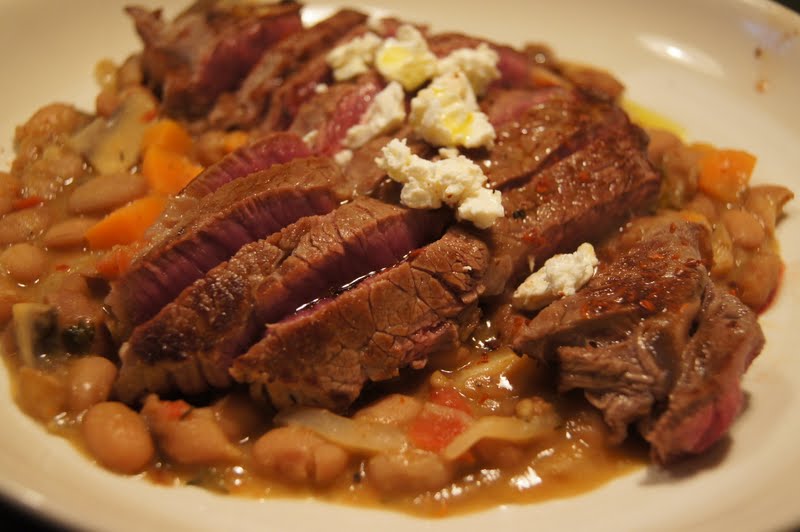
    I decided to go for a gentle bean stew flavoured with garlic and anchovy and topped with the sliced medium-rare beef. This 'meat on stuff' is something that seems to pop up in the St John school of cookery from time to time (and in it's satellite restaurants by default) and I rather like it.


    • beef, or lamb - or pork?
    • beans
    • onion and garlic
    • anchovy
    • carrot
    • dried chili
    • a little feta or similar cheese if you have some to hand


    Chop your onion, carrot and garlic fine. The carrot is very important here I found - a welcome sweet note amongst the other macho flavours. Fry them in olive oil gently and unhurriedly. You will need around 15 minutes or so. Add some crumbled dried chilli and your anchovies. Go easy with the little devils. I actually used Gentleman's relish instead which is a good back-up to have in the fridge.

    Add you beans - if you have time then soak some, otherwise canned will do fine. Relax, it's a week night. I went for a giant tin of wachtelbonhnen from one of my favourite Turkish grocers on Hoxton Street, which turned out, I think, to be pinto beans. Don't add to much liquid from the can. Season.


    When the beans are looking fine and dandy fry your steak and give it a couple of minutes to rest. Slice into semi-ribbons, flop it over the beans and dress with crumbled feta or similar and olive oil.

    Here the beans play as important a role as the steak. It's not an all-out meat-fest where the beef is king and all other ingredients mere lackeys. It's balanced. Have some nice red wine or maybe a strong beer with it, and Turkish bread.

    17 March 2011

    Big boy steak and chips

    turnips, looking strangely beautiful

    It's hard to add anything new to the description of good steak really - meaty and succulent, rich and savoury, umami-rich, sure. But nice steak sometimes really just tastes of cow. And I guess that's as it should be.

      beef and spinach

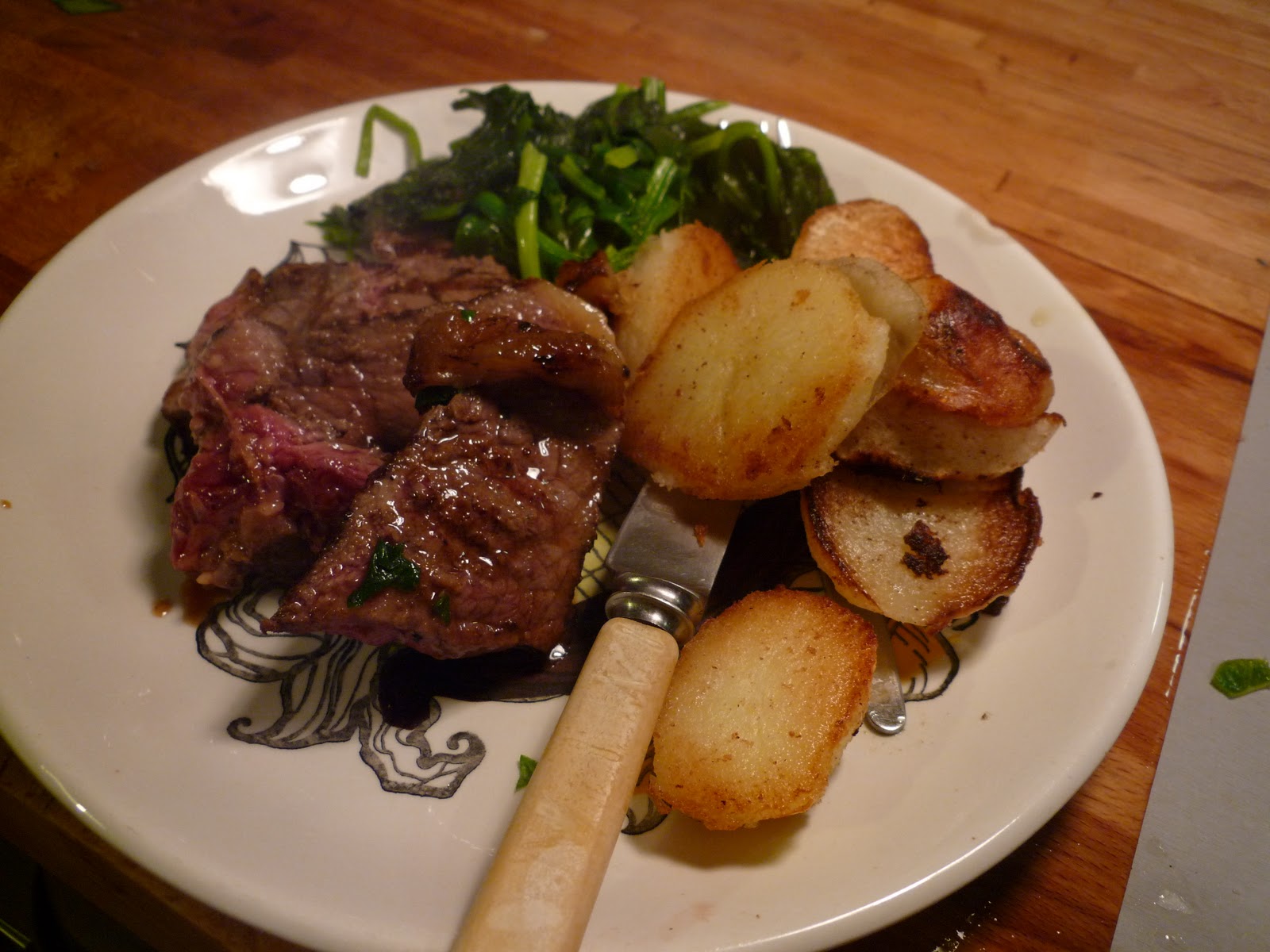
    So for this meal it's all pretty simple really. A lovely porterhouse (or is it T-bone...?) courtesy of Markymarket (follow @markymarket twitter) and spinach for the greens - an echo of grass for the cow on the plate. Fried potatos and turnips and some horseradish mayonnaise and it's good to go - the rightly revered trinity of meat, starch and veg.

    glossy

    Turnips are brilliant, standard. Slices boiled to 90% cookedness then fried in duck fat are amazing. I am positive these would be a good snack to have with a few pints of ale.


    The steak was cooked on a cast-iron ridged pan and rested for about twelve minutes.


    Just enough left over from this beast for a salad of meat, turnip and potato and baby spinach dressed with the horseradish mayo. This looks like something you might get at Bread and Wine - should go down a treat for lunch!


    2 March 2011

    Boiled beef slices in a fiery sauce (shui zhu niu rou)


    Until I had more properly explored Szechuan food through restaurants, FD's book and other sources the iconic dish to me always was (and still is to some extent) the giant bowl of hellish-red stock and oil strewn with chillies and Szechuan peppercorns. Having cooked and eaten a bit more now, I hope I have moved on from this perhaps slightly limited view of Szechuan food being hot-and-numbing above all else. This remains, though, a classic dish and something that needed to be tried at home. As ever, what I ended up with was a bit of an adapted version using the stuff I had to hand.

    For three:
    • 4/500g beef (go for a cheap braising steak type cut)
    • dried chillies, Szechuan peppercorns, chilli-bean paste, Shaoxing wine
    • ~1l stock
    • crunchy veg (lots) - whole head of celery, Chinese lettuce or cabbage etc
    • spring onions

    Marinade the beef (sliced) in Shaoxing wine and a little salt.

    Fry the chillies and SPs in plenty of oil and add a couple of tablespoons of chilli-bean paste. Fry for sixty seconds, stirring.


    Add the stock and two teaspoons of dark soy sauce and bring to a simmer. (FD talks about 'everyday stock' in lots of the recipes which is made with chicken bones and all the relevant spices. I never bother with that if I don't have anything to hand and just use water and a fat pinch of trusty vegetable bouillon and it's all good.)

    Add the beef and crunchy veg and cook until the rawness of the veg is broken and the beef has lost any pinkness in the centre. Be very wary of overcooking the beef as more than a few minutes will make it tough. Add spring onions very near the end so they have a minute of cooking but retain a a certain freshness.


    Try serving with smashed cucumbers. Smash them and chop them and salt them before doing anything else. After twenty minutes or so pour off the liquid they have exuded, wipe off any mega salt patches and mix in a mixture of sesame oil, rice vinegar, a little sugar, finely chopped raw garlic and pickled chillies (shown at the top) according to your preference.

    Enjoy! I cooked some noodles in the broth but obviously it would be great with white rice too. You really don't need a huge amount of meat in a dish like this. The counterpoint of the vegetables and the starch of the noodles we ate balance it perfectly.

      24 February 2011

      Red-braised beef with vegetables (hong shao niu rou)

      all hail fermented chilli-bean paste, food of the gods

      Refrshingly, the (European) received wisdom of starting every braise or stew by frying onions and browning the meat to maximise flavour does not apply here. Since they are two of the few things that take any time, the prep time of this dish is seriously short - under five minutes. The chilli-bean paste packs so much flavour it's all you need. I wonder if a crossover stew inclusive of these two steps, with many onions cooked down in the stock, would be a success?

      Fry chilli-bean paste in oil and add chilli and SP. I found the amount of SP specified by FD in the previous dish I made a bit on the conservative side so beefed it up by a factor of around three. Add the beef (something cheap and with fat/collagen to release) stock, a star anise, a drop of dark soy sauce for colour and some smashed ginger. Simmer for one or two hours, adding the veg to cook at an appropriate time.

      Big white radish aka mooli/daikon is specified here and is a lovely vegetable – porous and good at absorbing savoury liquids whilst retaining structural integrity and a decent crunch. I also had some common or garden radish and kohlrabi to use up from this salad and a depressed and wrinkled beetroot waiting aimlessly on the window sill. That went in too. Maybe not wholly authentic but it did the trick. To complete the low-effort ethos I just tipped in some noodles rather than bother to do rice.

      one-pot goodness

      I used ox cheek for this as Waitrose had some reduced to crazy cheap levels. Much as I've enjoyed it before it went almost too soft here, whilst maintaining a slight rubbery-ness that was not wholly pleasant. I can imagine shin being nice here: maybe it would be a touch more succulent.

      PS. Szechuan experts - do your Szechuan peppercorns have the hard gritty seed in the middle of the husk? Some of mine do and when you bite in to them it can get a bit emotional - perhaps superior stocks somehow have this bit removed? Thanks!

      8 November 2010

      Bolognese sauce

      There seems to be much made over what exactly goes into a Bolognese ragu. Milk or no milk, pork or no pork, red or white wine, lots of tomatoes or just a few. After doing a bit of reading on it I decided to give it a go with an emphasis on a strong meat flavour (to be provided by bacon, beef mince and chicken livers), a relatively modest amount of tomato, milk and a long cooking period. There seem to be fans of both red and white wine, I used white for a change to see how it was.


      Ingredients
        • onion, carrot and celery
        • beef mince, chicken livers and bacon in a ratio of 3:1:1
        • dried herbs (thyme and oregano for me)
        • tin of tomatoes
        • large glass wine and same amount of whole milk
        • olive oil


      The vegetables are first softened in olive oil for fifteen minutes or so with a little garlic. Some bacon scraps were browned and added to the vegetables, as was the mince and the chopped chicken livers. I then allowed this to all cook down for ten minutes. Then the wine and milk were added and dried thyme and oregano added to the mix. It was slightly grey at this point and did not in fact look hugely attractive.


      After a couple of hours the sauce had started to look a bit more together, although still far from the glossy red more normally seen. Some penne, a twist of salt and pepper and some parmesan finished things off. It was good but not mind-blowing. So, any tips or tricks for making a top notch version?


      30 September 2010

      Ox tongue with green sauce


      Tongue. There is something decidedly old-school about tongue, and especially its smell: corned beef and wartime mess-rooms as well as an animal hit of dog food.

       
      It is pure muscle. There are no bones and once the slightly weird looking bit at the bottom where it attaches to the mouth has been trimmed away there is no gristle. Having been already poached for another dish and then frozen this ox's tongue had already had its skin peeled off and was ready to go. I decided to go for green sauce as a suitably peppy sauce and serve it with mash and some simple vegetables.


      My green sauce = lots of parsley, a good amount of olive oil and much smaller amounts of Dijon mustard, raw garlic, capers, caper juice, red wine vinegar, salt and pepper. But I get the impression you can fiddle around plenty and that its make-up differs greatly from country to country. Other things with big and bashy flavours would be welcome: anchovy, dried chilli, herbs.


      The tongue was cut into strips and cooked in a heavy cast-iron griddle. It was served with white asparagus which wouldn't perhaps have been first choice but needed eating. Something a bit humbler would be better here maybe - swede, carrots, cabbage, sprouts.


      Check the angel wings Fergus Henderson talks about

      The tongue is bouncy and meaty. I feel that freezing may have toughened the outer layer somewhat but the inside part was very nice and looked the part with the charred griddle lines.

       
      Halva for pudding.