Showing posts with label quick. Show all posts

12 March 2012

Breakfast eggs with sobrasada


It's a self-evident truth that eggs are good for breakfast. It's also clear that pork of all kinds goes well with eggs. This dish joins the dots to make a quick, tasty and pretty damn tasty breakfast/brunch (or indeed lunch or tea).

Sobrasada is a soft, spreadable chorizo somewhat akin to nduja, although made with less evidently dog-food profile pork. I got this one at Brindisa at Borough Market for £4.50 which was ok as it's pretty big. The lady there recommended spreading it on toast or stuffing a chicken with it. I'd imagine it would go sensationally well in a bean based stew with garlic and paprika, or indeed with some shellfish. Funny how spiced pork becomes more seasoning than meat, ready to leand savour and charm to most other foods.


You are going to need -
  • spring onions, peppers and/or mushrooms, tomatoes
  • eggs
  • sobrasada (or nduja or another soft spiced sausage)
  • cumin, dried chilli, olive oil

I'd say spring onions are near essential for this dish. You could use normal onions but spring onions have the edge as they cook so quickly which keeps the food in the ten-minutes-on-a-hangover bracket. Chuck them in a pan with some olive oil, cumin and chilli flakes. Cook for a few minutes. Add a few sweet cherry tomatoes and some chopped red pepper and/or mushroom. Add the sobrasada. Fry all this for a few minutes so the tomatoes have broken down to make a sauce, the peppers are half way to being soft and the meat gives up some of its oil. Crack the eggs in (two each, natch) and leave on a low heat with a lid on the pan.


The lid helps to cook the eggs and you'll end up with a lovely consistency part way between baked and fried. Have some good crusty bread and you're good to go. They are quite slippery when removing from the pan as evidenced by the plate below!


If you fancy making some sobrasada yourself there is a recipie here. I've found that a little goes quite a long way and fully expect mine to last a while. Thick (and yes - unctuous) it is rich, highly flavoured and more versatile than, say, guanciale. Recommended.

17 January 2012

Mussels with celery, bacon, cream and cider


Mussels are something I don't remember to eat often enough. Wonderfully rewarding to eat and immensely easy to prepare they deserve cooking far more often. This is s simple way to do them, and Anglo-accented sidestep from the familiar moules marinieres with cream and white wine.
  • mussels
  • fatty bacon
  • celery
  • cream
  • cider
Fry your celery in slices with a little butter then chuck in the bacon. When the meat is browned and the celery softened but not totally surrendered add the mussels (do all the boring prep beforehand bla bla) and a bottle of interesting cider.


When the mussels have opened add some cream. Don't go mad. Make sure it's off the heat so it doesn't curdle. Add plenty of black pepper and serve with some bread.


My, that's an easy recipe. Needless to say more cider is advisable for drinking with the food. A little bit of parsley would be nice if you have some to hand but it's far from essential.

We had some amazing smoked trout with lentils to follow.


7 November 2011

Two ways with hot and nutty vegetables, Szechuan style


I'm blogging these two together as they are variations on a theme. Like the kindling noodles I cooked earlier this year, and heartily recommend, the selling point here is the combination of rich and oil nuts and/or seeds with chilli and vegetables. Sesame oil is used pretty widely in Chinese cooking for frying and flavouring and I know sesame paste is also utilized. I'm not sure exactly what that looks like but I've used tahini successfully in stir-frys and the like and it's ended up pretty well every time. All you need then is a load of vegetables and the rest of the ingredients take care of themselves - dried noodles or rice from the cupboard, sesame paste, chilli oil / dried chilli / pickled chillis, maybe a few nuts or preserved vegetables to liven things up and you're good to go. All things from the store cupboard. Crack a few eggs into the veg at the end if you're looking for more protein.
watch out for this type of pickled chilli - it's by far my favourite type so far and available in Chinatown - at about £1.50 it's worth stockpiling

pretty hedgehog patterns
  • mixture of peppers OR loads of sliced up aubergines
  • tahini, pickled chillies
  • soy sauce, shaoxing wine
  • garlic
  • mix of peanuts, walnuts and sesame seeds
Toast your seeds and nuts lightly in a pan for a few minutes, keeping an eye on any burning.


Fry your peppers or aubergines with some veg oil. With the aubergines it's of course essential to get them really soft and silky. I did this by putting a bit of water in with them and adding a lid - this ends up half steaming and half frying them. Do what ever works for you.

When the veg has started to cook down add a couple of teaspoons of tahini, a few shakes of soy sauce and your choice of chilli heat. Taste and adjust. Chuck in some other vegetables if you fancy - shredded cabbage went very well with the peppers, giving a textural foil and preventing monotony.


When the veg seems nearly cooked add your toasted nuts and again taste and tweak the seasoning as you see fit. Serve with noodles or flat bread if feeling lazy.


To compliment the sesame paste strategically deploy some sesame oil too.


Hot-and-nutty is up there combo wise with the holy mix of Szechuan food - the hot-and-numbing mala. I'm sure there must be a proper Chinese name for it if anyone knows..? Regardless, from satay, to West African peanut soups to Chinese sesame kindling noodles it's doing it for me big time.


18 August 2011

Cabbage, pasta, parmesan and chickpea soup


Like parsimonious Italian grannies, in my flat we've been saving the rinds of spent blocks of partisan for a moment such as this. Now they come to the fore and truly become themselves. Soup. To be specific, a kind of minestrone x pasta e fagioli bastard, miscegenation born of necessity. The cabbage, pasta, parmesan and chickpeas are the backbone of this dish - feel free to experiment with the other ingredients but I think these four should remain as the central pillars around which the flavour is woven. If you have some white wine to hand why not add a small glass to the pot?

  • an onions and some garlic
  • one cabbage
  • one tin chickpeas (or other beans)
  • parmesan
  • vegetable stock
  • pasta
  • olive oil
  • dried chilli
  • fresh basil (not crucial)


Chop your onions and garlic and cook in olive oil. Give them ten minutes or so to get properly translucent and nice. Add the parmesan rinds and some dried chilli.


Introduce stock, a shredded cabbage and a tin of chickpeas. A couple of minutes later put in some pasta (don't go mad with the amounts - it should compliment and not dominate the rest of the ingredients). Cook for ten to fifteen minutes and make sure everything is cooked. Now is not an al dente time. Season, add more olive oil if needed and stir in some grated parmesan. Add some basil at the end if you have some, it's not a big deal if you don't


This soup is a great example of a combination which exalts its humble components beyond the store-cupboard. The chickpeas and pasta give it main-meal heft, the cabbage gives you vegetable goodness and the parmesan, chilli and garlic keep things interesting. You could posh it up a bit bit that qualifies as gilding the lilly in my book.


20 July 2011

Red braised tofu (zhang gu ying you dou fu)


So. I'm still eating Szechuan and Hunanese food a lot. Maybe twice a week. As well as the recipes (generally from Fuschia Dunlop, but with some diversions into two or three other books I have) which I faithfully document on SDON I just do a general stir-fry with whatever is to hand. It's a great standby dish for week nights - take the vegetables you have in the fridge and chop. Fry some fermented bean paste with some chopped garlic and ginger for a minute, add the vegetables and cook briefly and you're done. Put a splash of soy sauce and sesame oil and eat with a pitta from the freezer (always have pitta to hand in the freezer - essential!) instead of rice and it only takes five minutes.

action shot of me chopping garlics

But it is nice to try 'proper' recipes. This one if from FD's Revolutionary Chinese Cookbook.
  • garlic, ginger, red chilli, soy sauce, stock, thickener
  • tofu (book suggests deep-fried puffs)
  • some veg (+ shittake mushrooms (optional))
  • spring onions (obviously)
  • red chilli

Fry the garlic and ginger in some oil and when fragrant add some stock. Add the tofu and cook for five minutes. Then add your soy sauce (a decent amount), chopped red chilli, veg and shittakes. Add the spring onions and thicken. Simple eh.


For a side side we had fried cucumber. The photo in the book (below) pairs them with purple perilla flowers but I just fried them in discs with a little dried chilli and a drop of vinegar at the end. Very nice. I included courgette too as it was lying around.


OK I admit I'm constantly jonesing for fermented bean paste, but to me this just wasn't as tasty as mapo tofu and the like. It was decent, and nothing a little chilli oil couldn't improve but not quite scaling the hights of some of the other classics. The cucumber thing is a keeper though.


27 June 2011

Fennel and cheese on toast


A very nice brunch of fennel slowly caramelised with a bit of butter and some brie. Use any soft cheese and give it a blast under the grill to make everything nice and sticky.

13 June 2011

Fried long green peppers (fu pi qing jiao)


Down Ridley Rd at the moment you can get about eight of these long green peppers for a pound. Amazing. I associate them with Turkish food usually and they would be wonderful fried up with garlic, cumin and olive oil and topped with yoghurt and a little sumac. However we also know that peppers of various forms are much loved in Szechuan. This is one of those mega simple combinations that really lack the necessary complexity to be considered a full on recipe. Just as they would be delicious fried with garlic and dressed with just olive oil and salt and pepper in an Italian style, all I did was fry them and give them a splash of vinegar and a dab of pickle. Simple. The flavours speak for themselves: stands to reason.


I used my new favourite - Wild Brake Pickle (飯掃光家常野蕨菜). Available (along with live eels last weekend) at the compact, excellent Yu Xiao in Dalston.


  • peppers
  • oil, Chinkiang vinegar, pickled vegetables or chilli

Fry the peppers. You need to achieve an appetising softness inside and a semi-blistered skin outside. Spots of blackness are desirable. These green peppers are spicy. I left the seeds in and they were fine.


    Dress with vinegar and a touch of your favourite pickle. You could go for some preserved mustard tuber or maybe some salted chillies. Consume. Great as a side dish: for a whole meal just muddle a couple of eggs in with the peppers and serve with rice a a slug of soy sauce.

    well tasty

    Sunflower Food Galore is a brilliant food blog covering Chinese food and more. You can check their take on this dish - Stir fried blistered green chilli - Hu pe jian jiao - 虎皮尖椒.

    27 May 2011

    Kindling noodles (yi bin ran mian)

    More noodles from Szechuan. Super easy. You are advised to make asap if you have not done so already dear reader.


    • noodles (I found plain flour ones worked very well)
    • chilli oil, soy sauce, sesame oil
    • walnuts, peanuts, sesame seeds
    • preserved vegetables, spring onions and green veg

    Kindling noodles, so called because the noodles look like small sticks of wood allegedly, appear in Fuschia Dunlop's consistently interesting book Sichuan Cookery but this is my simplified version. She bakes the nuts in the oven which I think is a waste of time as they are easily toasted in a pan. She suggests chopping them down to the size of rice which I'm sure is the authentic way to do things - I suggest leaving some a bit chunky for textural variety. It is traditional to serve the noodles nude with piles of oil, veg and nuts on top for excitement, but I've just stirred everything together for ease.

    Szechuan chilli oil is well worth making at home. It takes under five minutes. Get an empty jam jar that can take some hot oil without threatening your life with flying shards of glass, heat up some vegetable oil and pour it over dried chillies (whole and/or flaked), Szechuan peppercorns and a small amount of fennel seeds. It should go nice and red. I sometimes fry all the spices in the oil for a minute to get a good strong flavour going on and then decant the lot. The fennel adds a tang of aniseed, occasional but wonderful, to proceedings. When using the oil try dredging a bit of sediment from the bottom of the jar. Delish!

    In a big bowl combine chilli oil with dashes of light and dark soy - you are going to need quite a decent amount but can of course top up later. Add preserved vegetables - if you use Tianjin (highly salted cabbage) it needs a rinse, if you go for something else (you can get cucumber, turnip, cabbage, mustard greens, kelp and more besides very cheaply in little pouches in East Asian supermarkets) it won't. Both options taste great. Again, you need a decent amount but can add more later.

    the big bowl of goodness

    Toast the same amount of walnuts and peanuts in a dry pan, stirring on a lowish heat. After four minutes add the same amount again of seasame seeds. Keep stirring for another three minutes. Pound roughly in a mortar and pestle, leaving a few lumps in for texture. You want a rich, oily paste to form to help coat the noodles. Add to the big bowl.

    Put the noodles on to cook. They need loads of water. I never put enough in.

    Fry spring onions and green vegetables of choice (a cabbage type vegetable is my favourite for Szechuan food but you could also use spinach, cucumber etc) and when they look good combine with all the other ingredients and add the drained noodles.

    Stir and eat with the soy sauce, chilli and sesame oils your elbow.

    apols for blurred pic

    Well tasty, trust me. Nuts and chillis seem to have some special chemistry of mutual flavour augmentation. The basic mix of toasted nuts with chilli oil and soy sauce with noodles can of course take anything – leftover meat, a fried egg, egg cooked into the noodles, the preserved vegetables, tofu or just a glut of whatever is cheap and ripe down your market. It’s not something to be precious about: get experimenting!

    23 May 2011

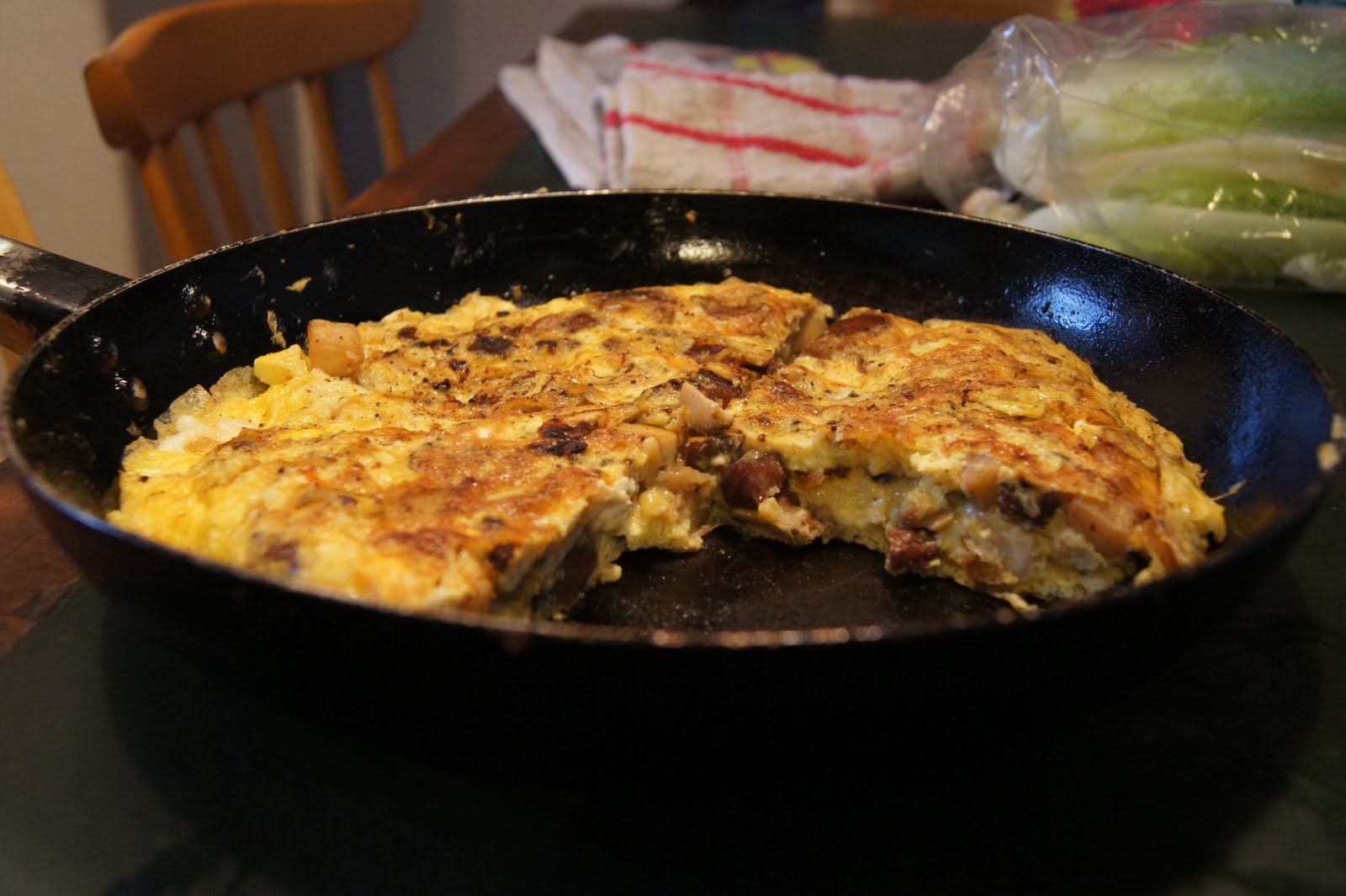
    Turnip and guanciale frittata


    I still have a drying crust of cured pig's cheek in the back of my fridge. The guanciale I paired with leeks to make a simple pasta dish has nearly been used up but I had a hunch that the little left would well compliment the lonely turnip below it in the salad draw. Two full and old-fashioned flavours: turnip and pig fat, surely both eaten (possibly in combination?, answers on a postcard) for centuries in farmhouses across much of Europe. We also had lots of eggs in the fridge and lots of eggs usually leads to one thing - frittata.

    Oh wondrous egg-based matrix! Ready to receive and cosset the humblest of foodstuffs.


    • eggs (quite a few)
    • guanciale (or another fatty pork product such as pancetta or chorizo)
    • turnip
    • nutty mushrooms

    Cut the guanciale into small dice. Being so fatty you want to get it really crisp and it's going to be harder to do this with bigger pieces (I wish I'd gone smaller). Set aside.

    Fry on a gentle heat to render the fat and being the crisping. Continue until tantalisingly browned.


    Cut the turnip and mushrooms into dice twice the size of the meat. Fry the turnip in the pork fat for ten minutes in a fairly low heat to cook and begin to caramelise. Add the mushrooms and fry for five minutes. Turnips respond well to black pepper: add according to taste.

    Reintroduce the guanciale.

    Beat the eggs and pour into the mixture. When it begins to firm up work over the bottom of the frittata with a spatula to prevent sticking. After five minutes either flip the frittata over by first transferring to a plate or finish under the grill.


    Serve with a salad and bread.

    with radish and beetroot salad

    20 May 2011

    Dan dan noodles (dan dan mian) (kind of)

    Just a quickie this one. Chicken breast is not normally something I have knocking around, possessing as it does a lack of taste and a monotony that almost renders it pointless (rubbish stuff that is), and generally fulfilling the meat needs of people who don't seem to actually like meat. But I got this stuff for cheap in a supermarket and I can never resist a bargain. Perhaps too, using up cheap ingredients and making do with what is available is all part of the traditional Szechaun approach to cooking! I wanted something quick and spicy. So I used a dan dan noodle recipe to try and make a chicken version of the Szechuan classic.

    • chicken (or minced pork for legit version)
    • noodles
    • spring onions and/or green vegetables
    • Shoaxing wine, Chinkiang vinegar, soy sauce, Tianjin preserved vegetables, chilli oil, Szechuan pepper

      Tianjin preserved vegetables

      Soak the noodles in boiling water. I used bean thread noodles which are transparent.


      Fry the preserved vegetables and set aside.

      Fry the meat and douse with some cooking wine, vinegar and soy sauce. Add some chilli oil and chopped spring onion. I added chopped courgette and spring greens here instead - obviously the flexibility of this type of cooking means you can use up whatever dregs are in your fridge at the back..

      When the meat is nearly done put the noodles in and add enough of their soaking water to ensure they  become fully cooked in the last couple of minutes that the meat needs. I didn't put in quite enough water at this point and the noodles retained a mild but unwanted bite.

      Toast some Szechuan pepper in a dry pan. Crush when fragrant (needs about four minutes - keep an eye on things to prevent burning).

      Taste and beef up the flavour with anything else it might need. I found it needed more than might be envisaged. I added some Hunan style home-fermented chillies too (the red below).


      Sprinkle with Szechuan pepper and serve. To be honest I don't think this works as well with chicken. The fatty, salty kick of the pork just marries so perfectly with the noodles and the spice. Still a decent and quick supper though.

      5 April 2011

      Chicken with cucumbers (ji chao huangguarding)

      home-preserved chillies Hunan-style - 
      just chopped red chillies and a pantagruelian salt portion!

      It think it's pretty clear from recent posts that I've got a lot of love for Fuscia Dunlop's Sichuan Cooking. But my enthusiasm for Szechuan (and Hunanese) food knows no bounds at the moment so I also picked up from Amazon's new-and-used section Mrs. Chiang's Szechwan Cookbook by Ellen Shrecker and the eponymous Mrs. Jung-Feng Chiang and The Good Food of Szechwan by Robert A. Delfs. The former is quite good whilst the latter I would not recommend purchasing.

      Mrs. Chiang's Szechwan Cookbook contains lots of classic dishes from the region, plus a few extra that aren't in FD's book like lion-head meatballs and some simple stir-fry combos like this cucumber and chicken one. The layout is slightly vexing, with the ingredients listed alongside the cooking directions so you have to scan the whole thing to get a sense of what's actually in it. But I think it's got potential to augment if not supplant Sichuan Cooking. (As an aside, the spelling 'Szechuan' is favoured in these two older American texts, whilst elsewhere you see 'Sichuan'. I have uses the former option is I think it looks nice with the zed, but I'm not sure how good a reason that is. I guess there is no clear transliteration.)

      Cooking cucumber has certainly been one of the revelations of getting into Szechuan food. So I liked the look of this simple recipe - chicken stir-fried with cucumbers and some classic flavourings of the region. 

      If you want to try the home salted chillies at the top of the page just chop some fresh red Indian type chillies and pour quite a lot of salt on to them (maybe 5-7% of their weight). Give them two weeks to mature. They might need a quick rinse to get some salt of before going into the food.
       
      • 1/3 cucumber per person
      • one chicken breast per person
      • two spring-onions per person
      • five cloves of garlic per person
      • Shaoxing wine, cornflour, pickled chilli, soy sauce, sugar, salt


        Slice the chicken and spring onion into similar sized pieces. You can see the size I went for, although the more authentic version in the book is based on quite small pieces. Marinade with the Shaoxing wine, a large dash of light soy sauce, pickled chilli, a pinch of sugar and another of salt, and a sprinkle of magic thickening dust for thirty minutes or so.

        Cut the cucumber into similar size pieces after eviscerating it with a teaspoon. Sprinkle with salt and leave to express its liquid if you have time. Otherwise just use as it is: I've often done this without any problems.


        Fry the cucumber for a couple of minutes to break the rawness and set to one side. Reheat the oil and add the garlic. Fry for thirty seconds. Add the chicken and spring-onion mixture and fry until it's cooked (only a few minutes). Tip the cucumbers back in and bring it back to full heat. Put in another slosh of soy sauce if you fancy. Serve.

        there's some noodles under here, honest guv

        It's quite a mild one this. You might not be satisfied if you're looking for a hot and fat chilli blast or associated numbing. But the ingredients definitely combine to make something more than the sum of their parts - something almost sweet and undoubtedly moreish.