26 April 2011

Dal 1 - yellow split pea


First of all: I've not been slacking. I've been on holiday. Within a few hours of returning to London we saw people fighting with knives in the afternoon at the top of Mare Street, Hackney Central. Young men running at each other in the road, one with a dog and one with a weapon in his hand.

Still, the weather was great and Hackney in the sun is easily one of the best places in the world. If you haven't sat in the the lovely garden of St John at Hackney or visited the nearby Sutton House (a National Trust property no less) then I recommended checking them both out. St John has a very nice walled garden.   

So, on to dal! Dal seems like a good idea most of the time. It's cheap, healthy if you go easy on the ghee, and most important of all, it tastes amazing. I'm going to cook dal till it tastes perfect. There are just so many recipes out there though - where's a man to start?  I decided to begin my quest by making a basic version using my modest knowledge of Indian cooking and then take it from there by researching other recipes. Here it is.


  • onions and a little garlic
  • cumin, coriander, turmeric, garam masala, green chilli,
  • yellow split peas
  • ghee

Cumin and coriander are such a good combination that it seemed wise to start with them.

Fry a couple of chopped small onions in three teaspoons of ghee for ten minutes with a little garlic. Add a teaspoon of coriander seed and three of cumin. Fry for another few minutes until you can smell them starting to give up their oils. Add two chopped green chillies (I keep a few in the freezer for times like this when you are cooking out the store-cupboard), a few shakes of turmeric and garam masala  and the yellow split peas (the amount in the jar above) and fry for a couple of minutes. I had originally thought these yellow discs were lentils but Wikipedia says otherwise. Wikipedia knows best.

When it's all looking good add about a litre of water and three cardamom pods partly prised open. These things need more cooking than you might think - they are pappy at twenty minutes, edible at thirty but really come into their own nearer fifty.

try with an islet of melting ghee on top

Very nice. Once the tongue-burning period well known to any glutton unable to resist freshly cooked food had passed the flavours opened up nicely. An earthy and honest base of flavour from the peas and the onion (you shouldn't be able to feel much onion in your mouth, it's all about them dissolving) with a satisfying underlying heat and flashes of something a bit more racy when you approach cardamom wake. Don't be tempted to put too much fat in this dish: it's appeal lies in its restrained and earthy tastes.

So, any winning dal recipes out there?

5 April 2011

Chicken with cucumbers (ji chao huangguarding)

home-preserved chillies Hunan-style - 
just chopped red chillies and a pantagruelian salt portion!

It think it's pretty clear from recent posts that I've got a lot of love for Fuscia Dunlop's Sichuan Cooking. But my enthusiasm for Szechuan (and Hunanese) food knows no bounds at the moment so I also picked up from Amazon's new-and-used section Mrs. Chiang's Szechwan Cookbook by Ellen Shrecker and the eponymous Mrs. Jung-Feng Chiang and The Good Food of Szechwan by Robert A. Delfs. The former is quite good whilst the latter I would not recommend purchasing.

Mrs. Chiang's Szechwan Cookbook contains lots of classic dishes from the region, plus a few extra that aren't in FD's book like lion-head meatballs and some simple stir-fry combos like this cucumber and chicken one. The layout is slightly vexing, with the ingredients listed alongside the cooking directions so you have to scan the whole thing to get a sense of what's actually in it. But I think it's got potential to augment if not supplant Sichuan Cooking. (As an aside, the spelling 'Szechuan' is favoured in these two older American texts, whilst elsewhere you see 'Sichuan'. I have uses the former option is I think it looks nice with the zed, but I'm not sure how good a reason that is. I guess there is no clear transliteration.)

Cooking cucumber has certainly been one of the revelations of getting into Szechuan food. So I liked the look of this simple recipe - chicken stir-fried with cucumbers and some classic flavourings of the region. 

If you want to try the home salted chillies at the top of the page just chop some fresh red Indian type chillies and pour quite a lot of salt on to them (maybe 5-7% of their weight). Give them two weeks to mature. They might need a quick rinse to get some salt of before going into the food.
 
  • 1/3 cucumber per person
  • one chicken breast per person
  • two spring-onions per person
  • five cloves of garlic per person
  • Shaoxing wine, cornflour, pickled chilli, soy sauce, sugar, salt


    Slice the chicken and spring onion into similar sized pieces. You can see the size I went for, although the more authentic version in the book is based on quite small pieces. Marinade with the Shaoxing wine, a large dash of light soy sauce, pickled chilli, a pinch of sugar and another of salt, and a sprinkle of magic thickening dust for thirty minutes or so.

    Cut the cucumber into similar size pieces after eviscerating it with a teaspoon. Sprinkle with salt and leave to express its liquid if you have time. Otherwise just use as it is: I've often done this without any problems.


    Fry the cucumber for a couple of minutes to break the rawness and set to one side. Reheat the oil and add the garlic. Fry for thirty seconds. Add the chicken and spring-onion mixture and fry until it's cooked (only a few minutes). Tip the cucumbers back in and bring it back to full heat. Put in another slosh of soy sauce if you fancy. Serve.

    there's some noodles under here, honest guv

    It's quite a mild one this. You might not be satisfied if you're looking for a hot and fat chilli blast or associated numbing. But the ingredients definitely combine to make something more than the sum of their parts - something almost sweet and undoubtedly moreish.

    30 March 2011

    Szechuan feast

    peanuts on the boil

    You need to eat with lots of other people to get the best of Szechuan food. All this food fed ten or eleven people.

    Aromatic peanuts (lu hua sheng) are just raw peanuts boiled with fennel seeds, star anise, Szechuan pepper, cloves and cinnamon for forty minutes. A good thing to have on the table before the meal starts. There's a moments confusion when you bite into them and find they're starchy and glutinous and not crunchy but they are very nice and dead easy to do. You can taste the anise quite clearly.


    Spring rolls were crafted by my expert co-cook from cabbage, carrot, spring onions, shiitake mushrooms, bean-sprouts and pickled bamboo shoots. Delicious, the mushrooms added a welcome chewiness and the bamboo crunch.


    Steamed aubergine (hong you qie zi) is again, super easy. Slice the aubergine (I omit the salting stage often specified by cooks/books including FD and have never had any problems) and put in a steamer with any flavourings you like. We went for fermented black beans, pickled chopped chilli and dried chilli flakes (just Turkish ones) but you could of course go for ginger, garlic, chopped spring onions, pickled vegetables or anything you fancy.

    before

    The wonder of the steamed aubergine is its texture: nearly as satisfying as a vigorously fried version, but thirstily drunk on water vapour rather than oil. An unexpectedly sweet smell emanated from this. They exuded lots of liquid which took on a sugary, malty taste that combined well with the spice of the chillies.

    after


    Cucumber salad (qiang huang gua) was just cucumber with the middle scooped out dressed with toasted dried chilli, Szechuan pepper and sesame oil. I forgot to smack these!


    Mopo tofu - we had Hunan style with shiitake but sans meat to accommodate vegetarian brethren/sistren.

    these are about 70p from Chinese supermarket - get involved!

    The recipe in FD's Revolutionary Chinese Cookbook: Recipes from Hunan Province specifies no less that four different preparations of chilli - chilli-bean paste, dried chilli, fresh chilli and salted chilli. Amazing. Check a full recipe for mapo tofu.

    all the flavourings ready for adding to the tofu

    the finished article


    Twice-cooked pork (hui guo rou) is normally done with pork belly I think. I had some fatty chops  described as Chinese chops or something similar (they were streaked with fat and not your classic bacon shape one) and used those. You gently poach the pork until it's just cooked, then cool. It's then sliced thinly and fried till the fat runs. Chilli bean paste, black beans, sweet wheaten paste (I used Hoisin which a guy in a Vietnamese supermarket in Dalston suggested) are added and then spring onions chucked in at the end. I also went for some red pepper too, which gives the dish a bit of colour. They'll need a few extra minutes to start to soften.


    Veg-wise we had cabbage, kale and bean-sprouts stir-fried with garlic and dressed with toasted sesame oil and Chinkiang vinegar.


    in a pretty pink bowl

    All in all a lovely meal to have with friends.

    28 March 2011

    St. George risotto


    The horrors of terrinegate scarred me deeply. Not since I used up the last of 2009's annual leave to stay at home and cook Mark Hix's horrid rabbit terrine have I been so bitterly disappointed by a pig's trotter. The meat from the recent terrine was put in the freezer (alas, the shame was not so easily hid) for a later point when I, at last recovered, could take it from its chilly home and erase the ignominy of that best forgotten day. That time is now.

    It's time, in fact, for a St George risotto. I just made up the name up to refer to do a risotto but with, err, English ingredients. I'd never done it before but it seemed like a good idea. The ingredients didn't really present any problems - plenty of leeks to start, barley has to do instead of rice, cheddar for parmesan and finished with the crisp meat. And how about a bit of mustard to flavour it all? Pork-Leek-mustard-cheddar. Nothing if not classic combos.


    • bacon or gammon or sausages
    • barley
    • cheddar cheese
    • lots of leeks (more than you think) and maybe a little spring-onion
    • peas
    • English mustard and a pinch of stock

    Fry the leeks in butter. I wanted them to feature quite prominently so used more than might be expected. I've got mad love for the leek. Add the barley (as if doing normal risotto). Add stock gradually. Don't worry about stirring too slavishly: the barley seemed perfectly comfortable with me nipping off every so often and leaving it alone. Brown the pork in a pan - you are going to need something with a bit of fat. When the barley is cooked but still toothsome stir in the cheese and English mustard (be neither timid nor extravagant), thrown in a handful of frozen peas and finish with the meat.

    looks the part, eh?

    It's great! The starch of the barley works perfectly and combines with the leeks, gluey when broken down, to produce a pleasingly sticky consistency. The barley has a nice springy texture that is lacking in rice.

    PS Mince and Skirlie did a St. Andrew's version - check it out! Great idea.

    24 March 2011

    Spicy braised fish with whole garlic (da suan shao yu)

    cold, dead eyes

    Just when you thought those spicy Szechuan sauces couldn't get any better... Whole garlic cloves - genius. This dish consists of a thick spicy sauce featuring all the usual suspects – chilli bean paste, ginger, spring-onions and dark soy – but this time with whole garlic cloves as well. An initial softening stage is required to partially cook the garlic and a ten minute spell of peeling is also needed. FD suggest cooking the fish in with the sauce but I think to keep things really simple next time I’ll just fry the fish separately. That way it’s easy to control the speed and rate at which the fish cooks, crisp up the skin and prevent it disintegrating the sauce.

    • dense, meaty fish (I used more Billingsgate mackerel from the freezer)
    • chilli bean paste, ginger, lots of garlic, dark soy, a smidgeon of sugar, stock/water
    • spring-onions


    Firstly prepare the garlic: peel a bulb of the stuff per person or more if feeling foolhardy. Fry on a medium heat for five to seven minutes with a stir every forty-five seconds. The skin should crinkle lightly but not darken in colour too much. The cloves should be moderately soft. Remove.

    Next, make the sauce: fry a few tablespoons of chilli bean paste in oil for thirty seconds and then add quite a lot of chopped ginger. Give this another minute or so – by now relentless heady waves of loveliness should be rolling off the pot and you should feel reassured and gladdened by the scent of frying chilli. Add a little splurt of dark soy and then top up with stock (or boiling water and pinch on stock powder) and reintroduce the garlic. You need enough liquid to make plenty of sauce: probably about 240 mills per person. Bring to a light boil to finish cooking the garlic.

    Meantime fry the fish (after slashing the body) with a little oil in any way you feel comfortable. A nice crisp skin will be provide admirable textural juxtaposition to the garlic nodules and spicy sauce.

    When the garlic seems pretty cooked introduce a little thickener (corn flour, potato flour etc) mixed with a dash of water to add gloss and thickness to the sauce. Add some chopped spring-onion at the last minute – FD suggests using the greens only (which is the authentic thing to do) but what’s a man to do with a load of half eaten spring-onions in his salad drawer? It all goes into my pot and I give them a minute or two on the heat to break the rawness of the white parts. (I forgot to add them this time which is why they are casually sprinkled on top.)
    should have put the fish and sauce on top of the noodles really

    Dish up the fish and pour the sauce over it. We had cabbage (the cannonball-heavy compact white type) fried with whole dried chilli, Szechuan pepper, chopped pickled chilli and dressed with Chinkiang vinegar.

    Another delight then: quick, easy and tasty as you like. I've run out of things to say about Szechuan food really. It's just seems so perfectly balanced: numbing, hot, sour, sweet, vinegary. It's flexible and good at accommodating errant or forgotten vegetables and odd bits of fish from the back of the freezer. It's relentlessly tasty and pretty spicy which is surely a major plus in the minds of right-thinking people everywhere. Perhaps I better just say I really like it. Hopefully I'm helping convince you that you may too.

    17 March 2011

    Big boy steak and chips

    turnips, looking strangely beautiful

    It's hard to add anything new to the description of good steak really - meaty and succulent, rich and savoury, umami-rich, sure. But nice steak sometimes really just tastes of cow. And I guess that's as it should be.

      beef and spinach

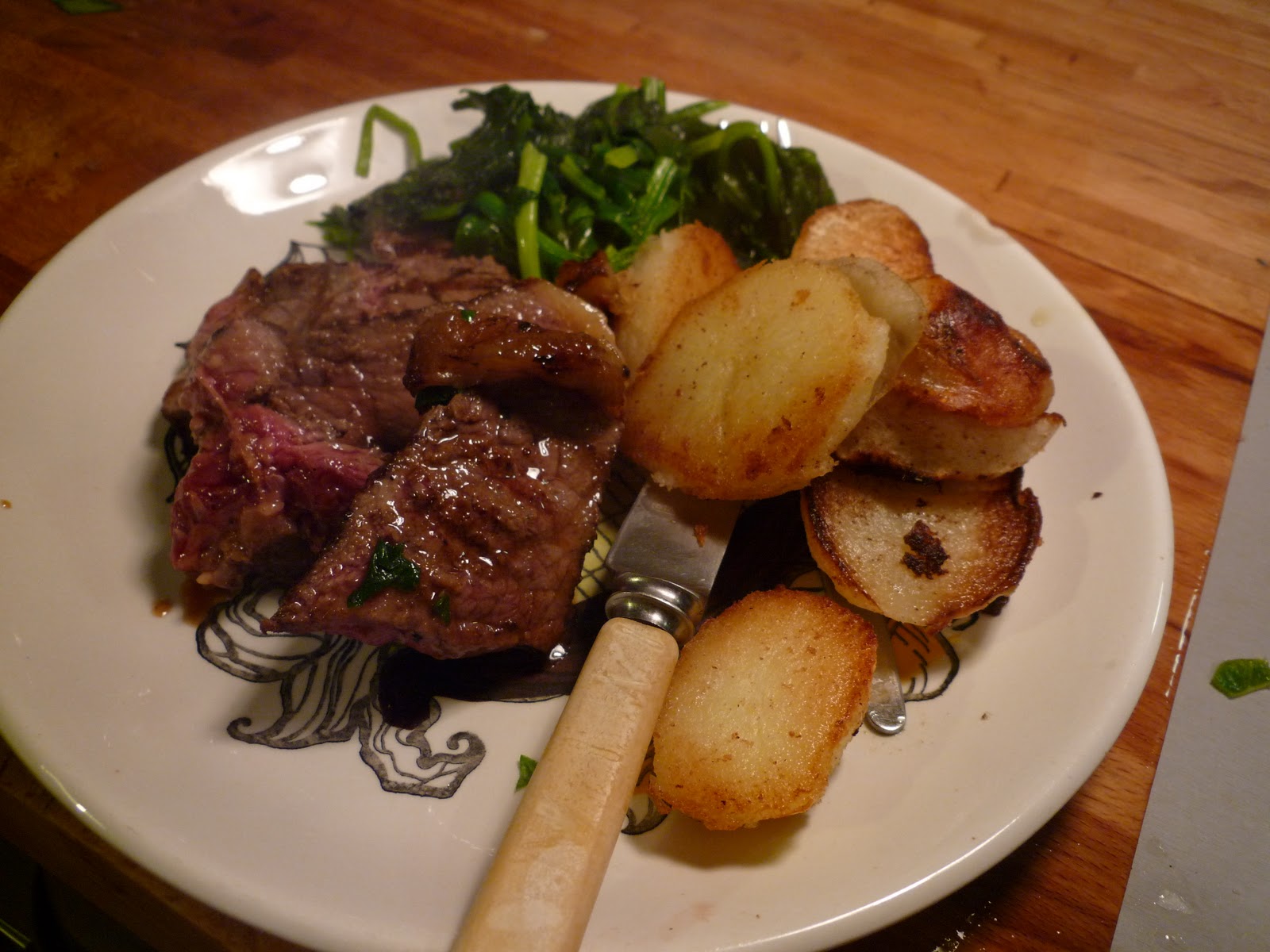
    So for this meal it's all pretty simple really. A lovely porterhouse (or is it T-bone...?) courtesy of Markymarket (follow @markymarket twitter) and spinach for the greens - an echo of grass for the cow on the plate. Fried potatos and turnips and some horseradish mayonnaise and it's good to go - the rightly revered trinity of meat, starch and veg.

    glossy

    Turnips are brilliant, standard. Slices boiled to 90% cookedness then fried in duck fat are amazing. I am positive these would be a good snack to have with a few pints of ale.


    The steak was cooked on a cast-iron ridged pan and rested for about twelve minutes.


    Just enough left over from this beast for a salad of meat, turnip and potato and baby spinach dressed with the horseradish mayo. This looks like something you might get at Bread and Wine - should go down a treat for lunch!


    7 March 2011

    Fish soup with pickled greens (suan cai yu)


    All this fun with chilli-bean paste had to end some time. It's regular and welcome appearance in my fridge, pan and mouth was making me forget the amazing Szechuan food that existed without the wondrous paste. It was time for a go at something else.

    This soup with pickled mustard greens and fish looked just the ticket as I had some super fresh mackerel from a trip to Billingsgate in the freezer. I thought an oily and meaty fish would stand up well for itself in a hot and sour soup filled with pickled vegetables.

    wonderful pickled mustard greens


    Here is a recipe modified from FD.

    • one mackerel per person
    • one pack pickled mustard greens (300g)
    • 1l+ stock
    • pickled chillies (if you have no Szechuan ones use Turkish)
    • Shaoxing wine, ginger, garlic
    • bunch spring onions

    Firstly fillet the fish and pour a little salt and Shaoxing wine over the fillets.


    Next you need a stock. If you have any fish stock to hand use (or maybe a light chicken one, just?), otherwise make a quick stock with the spines and heads of the fish, some appropriate spices and a pinch of veg stock. I boiled the bones (after smashing open the heads) with Szechuan pepper, a couple of dried chillies, fennel seeds, star anise, false cardamom and a scant handful of dried oyster and porcini mushrooms for some depth. I also added a small amount of Gentleman's Relish, containing as it does mainly anchovy and salt, this is a good short-cut when bolstering a fish stockStrain the stock well - lots of small black particles will have exited the fish heads and entered the liquid. My Le Creuset was a warlock's crock-pot of grey sediment and unidentifiable bits of mackerel matter by this point: muslin recommended.


    false cardamom - amomum subulatum

    Fry the garlic, chilli and pickled chillies, all cut fine. The yellow-green Turkish chillies that you get with kebabs worked great as they are a bit sour and suitably tangfastic. I asked Fuchsia Dunlop on her blog about the right pickled chillies to use and she was kind enough to reply. The ones in my previous post are a hot mountain chilli. What is needed here is the milder, sour ones - hence me using the Turkish option. I don't know what the authentic version of this soup tastes like and I don't think it matters hugely, but this substitution hits the right notes in my opinion.


    Add the strained stock and mustard greens (cut ragged). Add the chopped spring onions. Bring everything to a simmer and leave for five minutes to bring things to a head.

    Gently introduce the fish pieces and poach for a few minutes until cooked. FD suggests thickening but I loved the soup thin and broth-like. She also offers an option for chilli lovers of pouring on a layer of hot oil and Szechuan pepper. Now normally I'd be all over that, but the beauty, to me, of this soup lies in its soothing qualities. It is a balm, a tonic, and the pickled chillies give a gentle and suggestive heat that needs no augmentation. I saw somewhere the taste of the false cardamom described as 'antiseptic'. That's apt - initially I was worried by its strident flavour but the menthol notes of the pod assimilated well and added to the overall taste pretty well. You end up with a soothing savoury broth, the sourness of the pickled vegetables, some welcome squeak from the mustard greens and then the dense mackerel, surprisingly delicate in its liquid matrix. It tastes downright healthy this soup in fact.

    note the beautiful, miso-like, fine particle cloud of the soup

    I suggest eating this with a bowl of brown rice at your elbow.